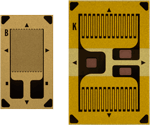
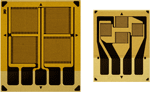
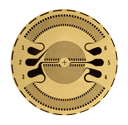
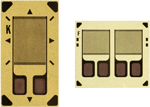
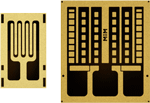
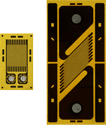
Transducer-Class
gages are available in the following
combinations of grid alloys and backings:
N2A
Open-faced constantan-alloy patterns constructed
on a thin, laminated, polyimide-film backing.
This series is capable of low and repeatable
creep performance. Construction is very
rugged,which will help prevent gage handling
damage.
J2A
Encapsulated constantan-alloy patterns. Both the
encapsulation and backing are thin, laminated
polyimide film. Gage soldering tabs are exposed
for simplified lead connections. Creep
performance is equal to the
N2A Series, although the presence of an
encapsulating layer will require a change in
creep code selection to maintain the same
performance.
EA
Open-faced constantan-alloy patterns with a
flexible cast-polyimide backing. Creep scatter
is somewhat more pronounced than with all other
series. Consequently, EA gages are normally
available with only one creep code per pattern.
N2K
Open-faced modified-Karma-alloy patterns
constructed on a thin, laminated, polyimide-film
backing. More rugged and flexible than the
TK or
SK Series, N2K gages are popular for
transducer applications where lower cost K-alloy
gages are desired. All N2K gages are supplied
with copper soldering pads (DP) for ease of
leadwire attachment. Most gages in the N2K
Series can also be
modulus compensated.
N3K
Special, open-faced, modified-Karma-alloy
patterns constructed on an ultrathin, laminated
polyimide-film backing. Their small size and
high resistance (5000 ohms) makes them ideally
suited for 4 to 20 mA process control
transmitters and battery-operated systems. All
N3K gages are supplied with a copper soldering
pad (DP) on each gage tab.
TK
Open-faced modified-Karma-alloy patterns with a
thin, reinforced, laminate backing. These gages
have a higher operating temperature range and
greater fatigue life than
N2A ,
J2A ,
EA ,
N2K , or
N3K gages. However, they are generally more
costly. Most gages in the TK Series can also be
modulus compensated. All TK gages are
supplied with a copper soldering pad (DP) on
each gage tab.
SK
Fully encapsulated, modified-Karma-alloy
patterns with a preformed solder dot on each
gage tab. Both backing and encapsulation are
thin, reinforced, laminated material. Due to the
relatively stiff backing and encapsulation,
SK-Series gages are less flexible than all other
series and care must be exercised in handling
and bonding. Some SK patterns can be supplied
with
modulus compensation (EMC) options.
J5K
Encapsulated, modified-Karma-alloy patterns
specially constructed to improve gage
performance at elevated temperatures. Because of
the laminated polyimide-film backing and
encapsulation, all J5K patterns are fully
flexible without being brittle. Copper soldering
pads (DP) are exposed for simplified lead
connections. Some J5K gages can be supplied with
modulus compensation (EMC) options. For best
high-temperature performance, J5K-Series gages
should be installed with
M-Bond 450 high-temperature adhesive.
J5E
A family of platinum-tungsten-alloy patterns
constructed with a thin, flexible polyimide
backing. Sensing grids are fully encapsulated by
a polyimide film overlay and include a preformed
solder dot on each gage tab. With a gage factor
more than double that of conventional strain
gages, platinum-tungsten-alloy patterns provide
standard transducer output levels at less than
half the normal spring-element stress values.
This allows for higher overload safety,
increased fatigue life, and improved linearity
in many transducer designs. A negative
gage-factor-versus-temperature slope also
provides modulus compensation in many types of
steel transducer spring elements. A relatively
high thermal output of platinum-tungsten alloy
makes precision static measurements difficult.
|